The Odyssey to Saturn: A Definitive Guide to the Cassini–Huygens Mission
Explore the full history of the Cassini–Huygens mission (1997–2017). Discover the historic landing on Titan, the water plumes of Enceladus, and the spectacular Grand Finale at Saturn.
 admin
admin
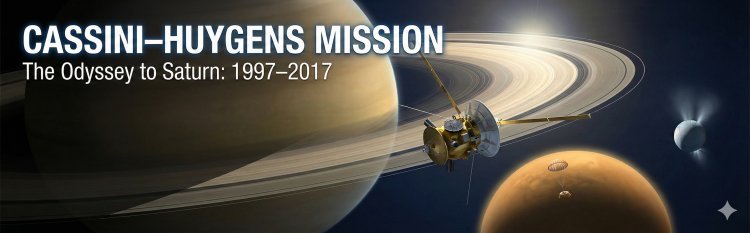
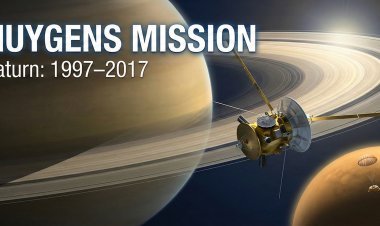
In the annals of space exploration, few endeavors match the ambition, longevity, and scientific return of the Cassini–Huygens mission.
A joint venture between NASA, the European Space Agency (ESA), and the Italian Space Agency (ASI), Cassini–Huygens was one of the largest, heaviest, and most sophisticated interplanetary spacecraft ever built.
1. The Machines: Two Explorers in One
The mission consisted of two distinct components attached together for the journey to Saturn: the NASA-built Cassini orbiter and the ESA-built Huygens probe.
The Cassini Orbiter
Cassini was a behemoth.
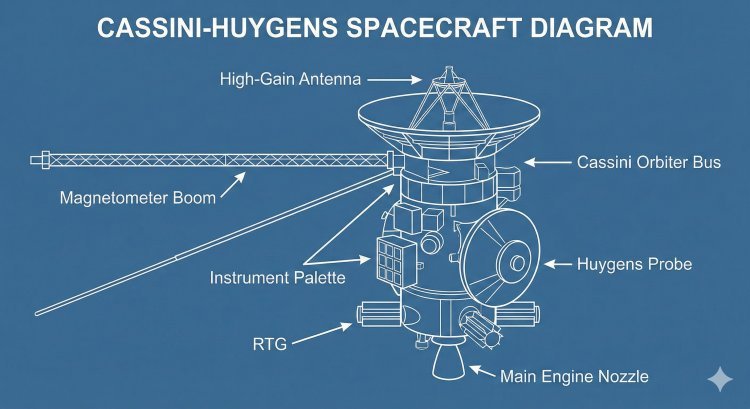
Because Saturn is too far from the Sun for solar panels to be effective, Cassini was powered by three Radioisotope Thermoelectric Generators (RTGs).
Cassini carried 12 major scientific instruments, including cameras for visible, infrared, and ultraviolet light; dust analyzers; plasma wave detectors; and a massive high-gain antenna used for both communication with Earth and for radar mapping of Titan's shrouded surface.
Attached to the side of Cassini was the Huygens probe, named after Dutch astronomer Christiaan Huygens, who discovered Titan in 1655.
Huygens was designed for a suicide mission: to detach from Cassini, plunge into the thick atmosphere of Saturn's largest moon, Titan, and survive long enough to send data back before its batteries died. It looked like a wok covered in gold thermal blankets. Its primary defense was a robust heat shield to protect its delicate instruments—including atmospheric sensors and cameras—from the intense heat of entry.
Below is a diagram illustrating the scale and components of the combined spacecraft.
2. The Long Trek Across the Void
Cassini–Huygens was too heavy to be launched directly to Saturn on existing rockets.
Launched on October 15, 1997, aboard a Titan IVB/Centaur rocket, the spacecraft first headed inward toward the Sun.
The Jupiter flyby was a scientific bonus. Cassini collaborated with the Galileo spacecraft (already orbiting Jupiter) to study the Jovian system, providing stunning imagery of Jupiter's storms and moons before continuing its journey into the deep cold.
3. Arrival and the Huygens Drop
On July 1, 2004, after a seven-year, 3.5-billion-kilometer (2.2-billion-mile) journey, Cassini arrived.
Touching an Alien World
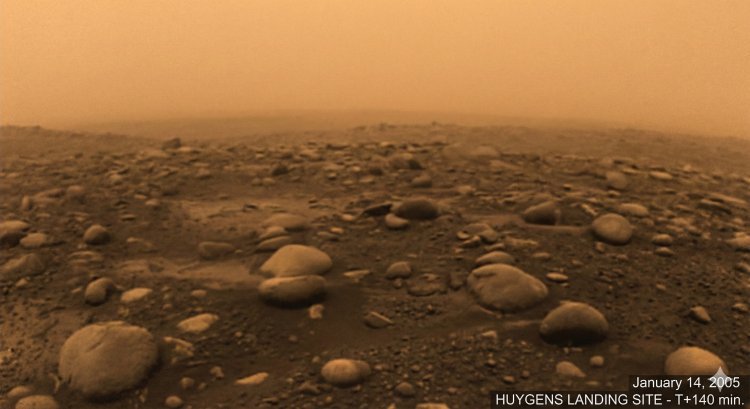
Six months after arrival, on December 25, 2004, the Huygens probe detached from Cassini. For 20 days, it coasted toward Titan, a moon larger than the planet Mercury, shrouded in a thick, opaque orange atmosphere made mostly of nitrogen and methane.
On January 14, 2005, Huygens hit the atmosphere. Its heat shield endured temperatures of thousands of degrees. A series of parachutes deployed, slowing its descent.
Huygens became the first (and currently only) spacecraft to land on a world in the outer solar system.
The image below shows the historic view from the surface of Titan.
4. A Decade of Discovery
Cassini's primary mission was slated to last four years, ending in 2008. However, the spacecraft was so robust and the discoveries so compelling that the mission was extended twice: the Cassini Equinox Mission (2008–2010) and the Cassini Solstice Mission (2010–2017).
The scientific bounty was immense, reshaping our understanding of the potential for life beyond Earth.
Titan: Earth's Twisted Mirror
Cassini's radar pierced Titan's hazy veil, revealing a world strangely similar to Earth, yet chemically alien.
Enceladus: The Icy Surprise
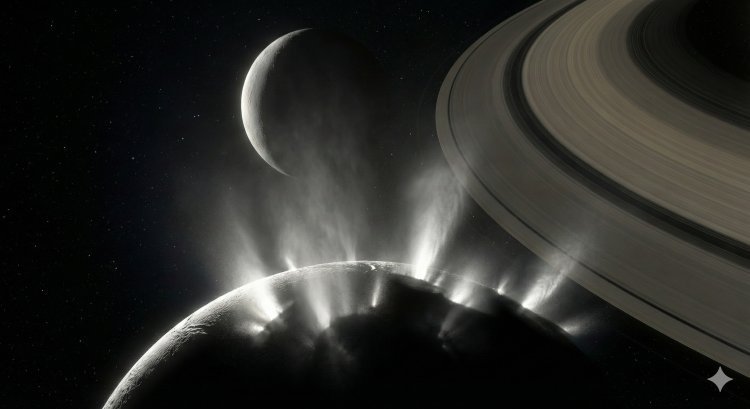
Perhaps the greatest shock of the mission came from Enceladus, a small, icy moon previously thought to be dead. Cassini discovered a geologically active south pole, scarred by four long fissures nicknamed "tiger stripes."
From these fissures, geysers erupted, spewing plumes of water vapor and ice particles hundreds of kilometers into space. Cassini flew through these plumes and detected salt and organic molecules, confirming that Enceladus harbors a global subsurface ocean of salty water beneath its icy crust.
The image below captures these spectacular plumes.
The Rings: A Dynamic Laboratory
Cassini revealed Saturn's rings not as a solid sheet, but as a dynamic system of billions of icy particles ranging from dust to house-sized chunks.
Saturn and Its Magnetosphere
The orbiter provided unprecedented views of Saturn's atmosphere, including a gigantic, persistent hexagonal storm at the north pole.
5. The Grand Finale
By 2017, after 13 years at Saturn, Cassini was running low on the rocket fuel needed to adjust its orbit.
The solution was a spectacular end to a spectacular mission: the Grand Finale.
Cassini used the gravity of Titan to slingshot itself into a daring new orbit.
Cassini survived 22 of these incredibly fast dives, collecting unique data on the mass of the rings, the planet's gravity and magnetic fields, and even sampling the atmosphere.
On September 15, 2017, Cassini began its final dive. It turned its antenna toward Earth, transmitting data in real-time as it entered Saturn's upper atmosphere. It fired its thrusters to fight the atmospheric drag, keeping its antenna locked on Earth for as long as possible.
6. Legacy
The Cassini–Huygens mission transformed our understanding of the Saturnian system and the broader solar system.
It provided a baseline of data that scientists will analyze for decades. It taught us that small, icy moons could be geologically active and possess subsurface oceans. It showed us a moon with lakes of methane and a thick atmosphere. It revealed the intricate, dynamic beauty of planetary rings.
Most importantly, the discoveries of Cassini–Huygens redefined where we look for life. Enceladus and Titan joined Europa (a moon of Jupiter) as prime targets for future astrobiology missions. The legacy of Cassini continues to inspire new missions, such as NASA's Dragonfly, a rotorcraft lander scheduled to explore Titan in the 2030s, building directly on the path blazed by Huygens.
The Cassini–Huygens mission was a testament to human curiosity and international cooperation, a voyage that turned the distant ringed giant into a familiar, yet ever-mysterious, neighbor.