Viking Era Mars Missions (1975–1976): A Giant Leap for Mars Science
 admin
admin
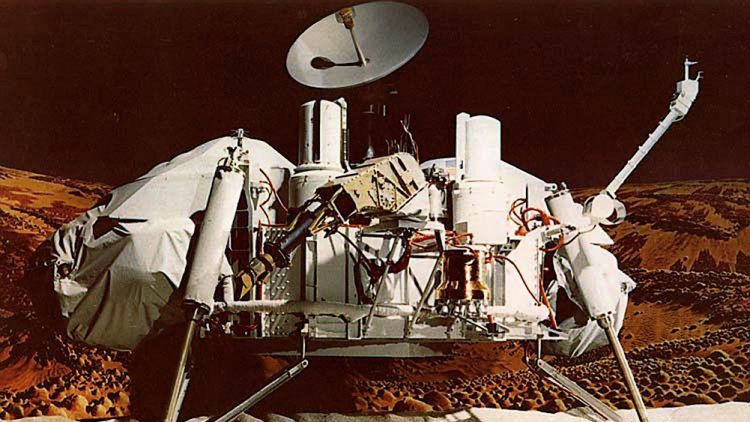
The Viking era marked the first time humanity touched the surface of Mars and searched for signs of life. NASA’s Viking 1 and Viking 2 missions, including both orbiters and landers, revolutionized our understanding of the Red Planet and remain a landmark in planetary exploration.
Mission Overview
-
Launch: Viking 1 (August 20, 1975), Viking 2 (September 9, 1975)
-
Arrival: Viking 1 entered Mars orbit on June 19, 1976, Viking 2 on August 7, 1976
-
Landings: Viking 1 lander touched down on July 20, 1976; Viking 2 lander on September 3, 1976
-
Mission End: Orbiters and landers operated for years—Viking 1 lander was last to shut down on November 13, 1982.
-
Cost: Approximately $1 billion in 1970s dollars (about $6 billion today), making it one of the most ambitious and expensive planetary missions up to that time.
Objectives
-
Search for life: Conduct the first-ever biological experiments on another planet.
-
Image Mars: Return high-resolution photographs from orbit and the surface.
-
Analyze atmosphere and soil: Study the composition, structure, and weather of Mars.
-
Map the planet: Create detailed global maps using orbiter cameras.
-
Test new technology: Pioneer soft landing, long-duration surface operations, and direct Earth–Mars communication.
Spacecraft Design
Each Viking mission consisted of an orbiter and a lander, working together as a pair:
Orbiter
-
Size: Octagonal, about 2.5 meters (8.2 feet) across
-
Solar Panels: Four wings, generating 620 watts at Mars
-
Cameras: Twin high-resolution cameras for global mapping and landing site selection
-
Instruments: For imaging, atmospheric water detection, and thermal mapping
Lander
-
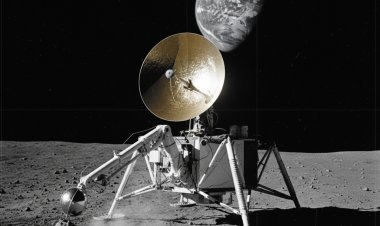
Structure: Hexagonal base on three legs, housing all scientific instruments
-
Power: Two plutonium-238 RTGs (radioisotope thermoelectric generators), each providing 30 watts
-
Cameras: Two scanning cameras for 360° panoramas and color imaging
-
Arm: Robotic sampler arm to collect soil for analysis
-
Instruments: Biology experiment, gas chromatograph–mass spectrometer, X-ray fluorescence spectrometer, seismometer (Viking 2 only), weather station, magnet, and mirrors.
-
Sterilization: Landers were heat-sterilized to prevent Earth microbes from contaminating Mars.
Scientific Achievements
-
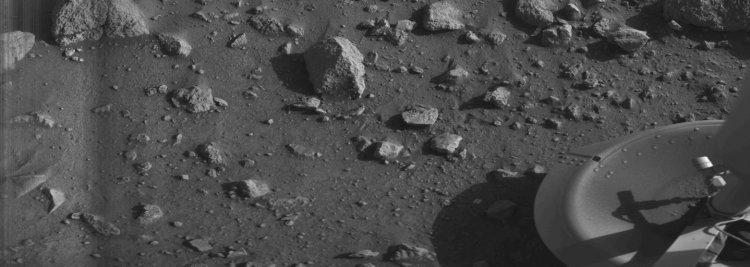
First Surface Images: Viking 1 returned the first-ever clear photograph from the Martian surface just minutes after landing—a historic moment in space exploration.
-
Global Mapping: Orbiters imaged nearly the entire planet, revealing volcanoes, canyons (including Valles Marineris, the largest canyon in the solar system), ancient river valleys, and evidence of past water flow.
-
Soil Analysis: Landers found iron-rich clay soils, with temperatures ranging from -120°C to -20°C. The atmosphere was thin (about 0.6% of Earth’s pressure), mostly carbon dioxide, with traces of nitrogen and argon.
-
Weather Data: Recorded daily and seasonal changes, dust storms, and pressure variations.
-
Life Detection: Three biology experiments searched for metabolic activity. One experiment initially gave a positive result, but the lack of organic molecules in the soil led most scientists to conclude the result was due to unusual soil chemistry, not life. The question of life on Mars remains open.
-
Seismic Data: Viking 2’s seismometer (Viking 1’s failed) detected only wind, not marsquakes.
Timeline Highlights
| Event | Viking 1 | Viking 2 |
|---|---|---|
| Launch | Aug 20, 1975 | Sep 9, 1975 |
| Mars Orbit Insertion | Jun 19, 1976 | Aug 7, 1976 |
| Lander Touchdown | Jul 20, 1976 | Sep 3, 1976 |
| Orbiter End | Aug 17, 1980 | Jul 25, 1978 |
| Lander End | Nov 13, 1982 | Apr 11, 1980 |
Legacy
-
Foundation for Future Missions: Viking set the standard for Mars exploration. Its technologies, such as soft landing, surface imaging, and sample analysis, paved the way for all subsequent Mars landers and rovers.
-
Public Inspiration: The first color images of Mars captivated the world and inspired generations of scientists and engineers.
-
Enduring Questions: Viking’s ambiguous biology results continue to fuel scientific debate and motivate new missions to search for life on Mars.