Chandrayaan-3 (2023): India's Historic Lunar South Pole Landing
Relive ISRO's historic Chandrayaan-3 mission. Discover how the Vikram lander & Pragyan rover made India the first nation to land near the Moon's South Pole.
 admin
admin
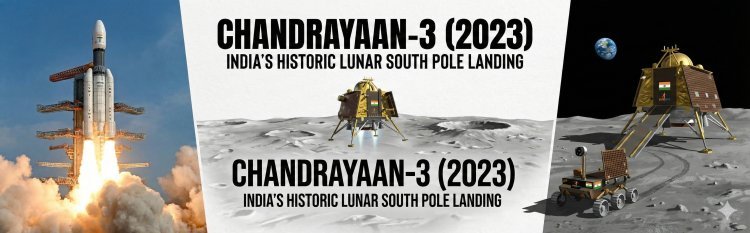
Chandrayaan-3 is the third lunar exploration mission by the Indian Space Research Organisation (ISRO).
Mission Objectives
The mission had three main predefined objectives:
-
To demonstrate a Safe and Soft Landing on the Lunar Surface.
-
To demonstrate Rover roving on the moon.
-
To conduct in-situ scientific experiments.
The Spacecraft and its Components
The Chandrayaan-3 spacecraft was a composite of three modules:
-
Propulsion Module: This module carried the lander and rover configuration from the Earth's orbit to a 100 km lunar orbit. It also carried a scientific payload, SHAPE (Spectro-polarimetry of Habitable Planet Earth), to study the spectral and polarimetric measurements of Earth from the lunar orbit.
-
Lander Module (Vikram): Named after Dr. Vikram Sarabhai, the father of the Indian space program, the lander was designed to execute a soft landing on the lunar surface.
It carried several scientific payloads: -
ChaSTE (Chandra's Surface Thermophysical Experiment): To measure the thermal conductivity and temperature of the lunar topsoil.
-
ILSA (Instrument for Lunar Seismic Activity): To measure seismicity around the landing site.
-
RAMBHA-LP (Langmuir Probe): To estimate plasma density and its variations.
-
-
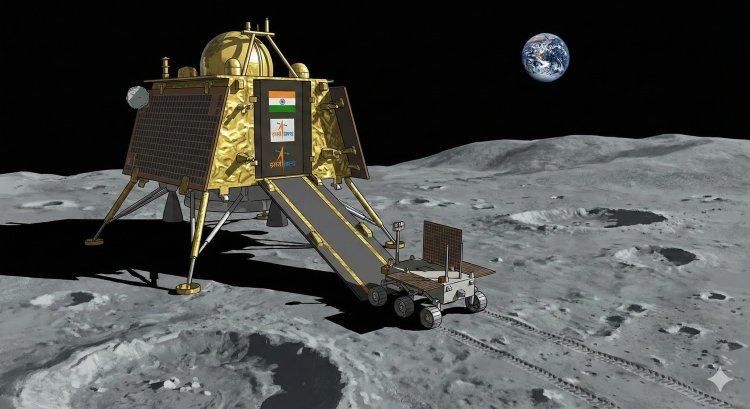
Rover Module (Pragyan): The six-wheeled robotic vehicle, Pragyan ("wisdom" in Sanskrit), was housed inside the lander.
It was designed to roll out onto the lunar surface and conduct chemical analysis using its payloads: -
APXS (Alpha Particle X-ray Spectrometer): To determine the elemental composition of the lunar soil and rocks.
-
LIBS (Laser Induced Breakdown Spectroscope): To derive the chemical composition and infer mineralogical composition of the lunar surface.
-
The Journey to the Moon
The mission began with a flawless launch from the Satish Dhawan Space Centre in Sriharikota.
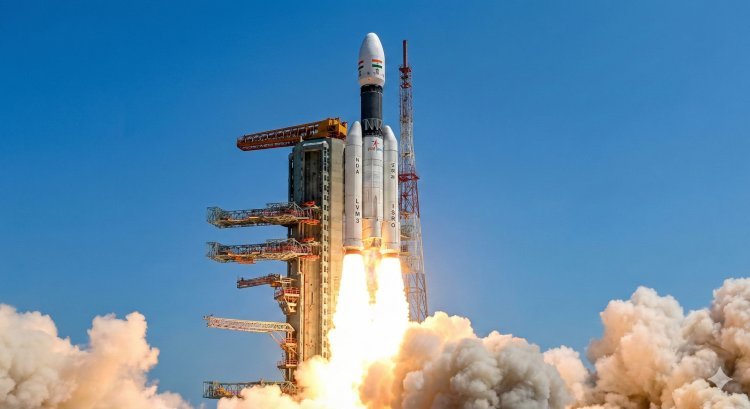
Over the next few weeks, ISRO performed a series of Earth-bound maneuvers to raise the spacecraft's orbit.
The Historic Landing and Rover Rollout
The final and most critical phase of the mission, the powered descent, began on August 23, 2023. The Vikram lander performed a series of complex braking maneuvers, autonomously scanning the surface for a safe landing spot. At 6:04 PM IST, Vikram made a soft and precise touchdown at its primary landing site (69.37°S, 32.35°E), which was later named Shiv Shakti Point.
A few hours after the historic landing, the ramp on the Vikram lander was deployed, and the Pragyan rover successfully rolled out onto the lunar surface, leaving the imprint of the ISRO logo and the Indian national emblem on the lunar soil.
Scientific Discoveries and Achievements
For the next 14 Earth days (one lunar day), both the lander and the rover conducted a series of experiments, sending back valuable data. Some of the key findings included:
-
Lunar Temperature Profile: The ChaSTE payload on the Vikram lander provided the first-ever temperature profile of the lunar topsoil around the south pole.
The data showed a surprising and sharp temperature variation, from around 50°C at the surface to -10°C just a few centimeters below, indicating the highly insulating nature of the lunar regolith. 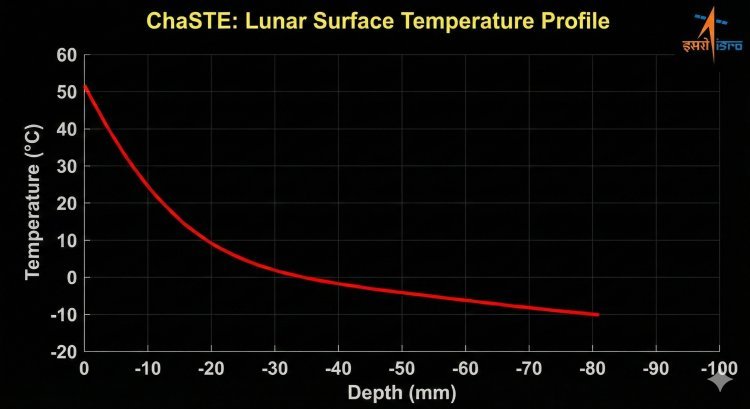
-
Detection of Elements: The LIBS and APXS payloads on the Pragyan rover confirmed the presence of Sulphur (S), Aluminum (Al), Calcium (Ca), Iron (Fe), Chromium (Cr), Titanium (Ti), Manganese (Mn), Silicon (Si), and Oxygen (O) in the lunar soil.
The detection of Sulphur was a particularly significant finding. -
Seismic Activity: The ILSA payload on the lander recorded the vibrations from the rover's movements and also detected a natural seismic event, providing the first seismic data from the lunar south pole.
-
Plasma Density: The RAMBHA-LP payload made first-ever measurements of the near-surface lunar plasma environment over the south polar region.